
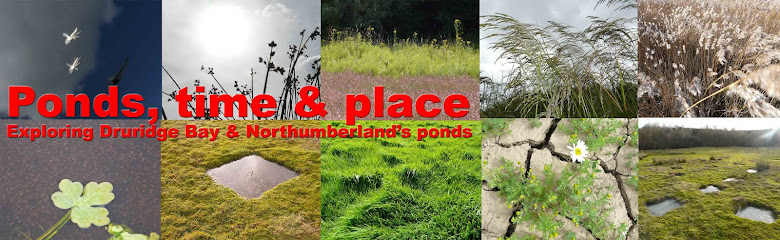
Druridge Bay, an eight mile arc of sand running north from Cresswell to the harbour of Amble in Northumberland, strewn with wetlands. From lagoons stained the deepest green by summer algae to flooded tyre ruts, glinting water in the arable fields. This blog is a snapshot of research at the University of Northumbria as we explore this pondscape forged between northern sea and sky.
Sunday, 28 July 2013
To the Bronze Age in search of a Tsunami

Friday, 19 July 2013
Cows, coypu and the ectozoochory taxi


This
pond was a verdant swamp of spike rush and jointed rush a year ago, but the
clumps of rushes are now bitten down to stumps and the mud poached by hooves. I’d
like to know if the livestock can carry pond life from site to site; ectozoochory,
to give hitch-hiking on an animal its scientific name. Whilst the expansive bulk
of cattle seem a likely form of transport smaller animals can be good vectors
too. One of my favourite studies is of things washed from the fur of coypu
living (or, had been living) in the Carmargue in the south of France. The coypu
had been shot, not part of the study, but as a control programme and Aline
Waterkeyn and her colleagues hosed down the corpses to see what the coypu had
been carrying. Waterfleas and rotifers, midge larvae and worms, Ostracods and
springtails all came off in the wash (Hydrobiologia, vol 652, pp267-271). The
water-fleas were particularly species associated with aquatic plants, which
fits the herbivorous habits of the coypu. I have a soft spot for coypu, having watched
them when I grew up in East Anglia. They would come out of the wetlands and “moo”,
slightly forlorn, as if aware of their unloved status. I tried coypu curry once
too. The coypu are gone from England now, eradicated due to their impact on
crops and river bank defences. Like the coypu of the Camargue the cattle of Druridge
Bay are likely vectors, and they moo.
Monday, 8 July 2013
Bad year, good year. Or, perhaps the opposite

The photos above show the margins of a subsidence pond in one of the pasture fields north of Cresswell village. On the left hand side the pond in July 2012, as the record breaking wet summer swelled the wetlands throughout the Bay. To the right the same pond in July 2013, as the first proper heatwave since 2006 takes hold. The weather during 2012 was a startling combination, opening up with a lingering winter drought that broke in April, to be followed by weeks of high rainfall punctuated by occasional exceptional downpours. Homes were flooded, roads closed or washed away and crops destroyed. Wildlife certainly suffered, most conspicuously the familiar butterflies of summer with the often overlooked cabbage whites suddenly becoming things of rare and flimsy beauty. This year seems better, although the high summer skippers and brown butterflies are taking their time to first appear on the wing. But which pond looks in the best health? In 2013 the same pond is but a puddle, the rushes and grasses stunted and grazed. Admittedly in 2012 no sheep or cattle were kept out in the fields, instead taken inside to weather the weather, so this year the verdant grasses, including the likes of the very palatable Flote grass, (Glyceria fluitans), have been nibbled to stumps. Again, 2012 looks in retrospect, like a boon year for many of the wetland plants.
Thursday, 27 June 2013
Parliament, ponds and extreme weather

The Houses of Parliament are so familiar that it is easy to forget just what an extraordinary confection of ornamentation they are. There is not a square inch lacking in Victorian flourishes of heraldic arms, gothic crenulations and worthy relief sculpting. Standing outside the Palace the whole structure radiates a slightly alien feel, as if inside its own protective force-field amongst the throng of tourists. I was there for the launch of The British Ecological Society’s latest publication, a review of the impacts of extreme weather on freshwaters in the UK. A tricky document to pull together because studying extreme events is an ad hoc science, replying on unforeseen opportunities as drought or flood strike the UK and often lacking reliable data from before the crisis against which any impacts can be judged. Nonetheless the review pulls together evidence from lakes, rivers and ponds and paints a fascinating picture of the changeability and resilience of our freshwaters. The broad message is that our freshwaters are vulnerable and can show rapid degradation, but nature bounces back so long as there are refuges elsewhere in catchment or wider landscape from which the wildlife can recover (the whole document can be downloaded at http://www.britishecologicalsociety.org/public-policy/our-position/ecological-issues/)
Northumberland, and Druridge Bay, feature large in the review, because I helped write the report and they are what I know best. In particular the Hauxley experimental ponds are an unusual example of a long term study, around long enough to have been hit by extreme rainfall and prolonged droughts. The impacts of the June 1997 deluge in Northumberland, an event so unusual that it may be a 1 in 300 year event, are shown in the report in photos of the River Wansbeck strewn with ripped up bulrushes and the Hauxley ponds are pictured because of the thick mats of algal that developed when the ponds did not dry out, with the result that other wildlife was partly smothered out. Odd but also charming to be thinking of Druridge Bay and Hauxley in the wood panelled grandeur of the palace of Westminster, crackling with power and the hushed sound of crustless finger sandwiches being hoovered up.
Friday, 21 June 2013
Ponds and the creativity of extreme weather


2012 has become infamous as the
wettest year on record in England. Infamous, at least, in England. This has been
followed by a peculiarly long winter, the coldest for fifty years. Britain has
had a run of wet summers. One outcome was a recent meeting by climate
scientists hosted by Exeter University to try and make sense of the signals from
the noise and ,perhaps, the causes. The immediate driver appears to be the jet
stream, which has not been shifting as far north has it once did and, instead,
acts as a conveyor hauling Atlantic depressions across the UK, one after the other.
However what causes the jet stream to linger so far south remains unclear (http://metofficenews.wordpress.com/2013/06/18/meeting-on-uks-run-of-unusual-seasons/)
. Ponds make immediate and powerful indicators of the impacts of these variations
in our climate. The photos above show one of the subsidence ponds at Blakemoor
Farm in the summer of 2012, when it was festooned with deep banks of Celery
Leaved Buttercup, to summer 2013, when it has dried out, leaving a few forlorn
tufts. What is the most worrying; being awash or being dried out? Neither. The
pond comes and goes and with it the vegetation. The animals are less obvious
but they too wax and wane between years. The extreme year of 2012 created an opportunity
for plants and animals that seldom colonised or, even if they did, dominated
the ponds. The ability of a landscape to vary has always struck me as important, although a
tricky thing to measure, given how short term so much of our research is. We find it hard enough to describe what we can capture and count, letalone something as abstract as the potenital to change. The
variation between years has added to the overall biodiversity, allowing wet and
dry year communities to flourish. The risk is that we have not recorded enough
data for sufficient years to spot any major step changes, those thresholds
beyond which the stage is re-set and some of the cast of ecological characters never re-appear.
Saturday, 15 June 2013
The fairy fern hints at summer


In a warm year they form a dense mat over the surface of Ellington pond, deceptively like a lawn but, on closer inspection, a serrated fuzz of fronds oddly resembling the jagged canopy of a conifer plantation in miniature. For me the dense mats seem to coincide with drousy, heavy weather, thunder threatening through the heat in late August. In a bad year, when the cold and wet do not suit their west coast roots, they hunker down in circular rafts, nestled amongst the other plants around the edge of the pond. The managers of Ellington Pond have tried to be rid of it, but even one tiny frond is enough to retain a bridgehead and begin the recolonisation. Quite how Azolla got to Ellington remains a mystery and the fronds have not turned up further north in England, although a scatter occur throughout the Central Belt in Scotland. There is a touch of exotic mystery to its presence, almost a glamour, entirely consistent with the Bay’s sense of being between worlds.
Saturday, 8 June 2013
The fret of June

June opens with a week of proper summer warmth, an immediate slap of sunshine you can feel faintly crisping you skin. Sunny days along the Northumberland coast can have a mysterious quality. Out over the sea there are low banks of grey and brown clouds that drape from horizon to horizon a bit like those curtains around beds in hospitals. The North Sea is lost behind them. These are banks of sea fret, condensing out over the cold water. Up at the Bay the fret has been advancing and retreating in probing attacks. Tongues of sea mist drift in for an hour or two, swathing a field or dune, the sun still visible if you look up through the shallow pall of mist, then pulling back to the sea. The fret brings a tingling, hair-on-the-back-of-your-neck drop in temperature as the moisture drifts past. The droplets shred and catch on hawthorn and bramble, traces of mist visibly rolling and tumbling inland then retreating back to recharge out at sea. This has been a dry spring and the subsidence ponds in amongst the field drops are shrinking, some barely wet. The deluges of 2012 resulted in verdant borders of Celery Leaved Buttercup, Toad Rush and Pineapple Mayweed turning many of these pools into vivid summer circles, but 2013 threatens the opposite. This begs a question of those of us who regularly survey pond sites: is one year’s data, a snapshot, sufficient to characterise a pond? Probably not, or, at least a snap shot cannot capture the extent of change across the pondscape. Some ponds do not seem to vary much from year to year. For others the very variability is their most striking feature. One boon to the work at Druridge Bay is that we have got to know the sites well and have sense of time as a factor in the ponds’ ecology. This year I’ll be re-surveying the vegetation of the ponds at Blakemoor to compare to the summer 2012 plants. For now though I’m enchanted by the fret seeming to briefly stop summer and hide the ponds from our gaze.
Subscribe to:
Posts (Atom)